
$
PROENGIN AND HEXADRONE: A STRONG PARTNERSHIP FOR REMOTE CBRN DETECTION BY DRONE, FROM ALERT TO DECISION
Proengin
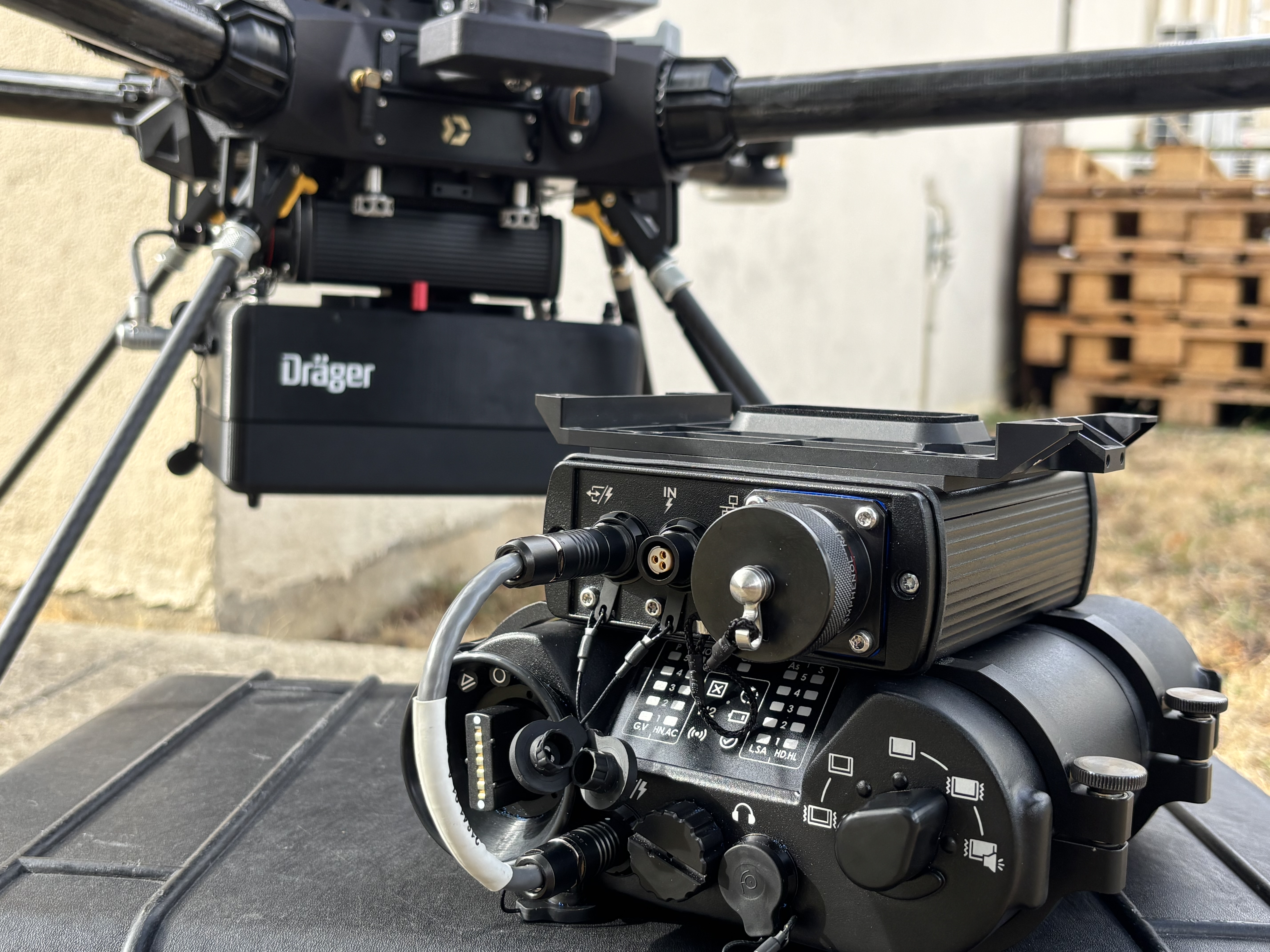
Integrating CBRN detection capabilities onto the TUNDRA 2.1 platform enables military, civil protection and security forces to detect threats remotely, transmit information in real time, and gain an actionable operational picture to support decision-making.
Saint-Cyr-l’École, September 3, 2026 — Proengin and Hexadrone are combining their expertise to develop a new capability for remote CBRN detection using drones. The partnership brings together Proengin’s expertise in CBRN threat detection and management with Hexadrone’s modular TUNDRA 2.1 platform.
Built around a clear operational objective — bringing detection capabilities closer to the threat while keeping operators at a safe distance — the partnership has led to the development and testing of several configurations combining Proengin technology with complementary sensors.
Beyond simply mounting a detector on a drone, the ambition is to connect detection to a broader operational picture: detect, locate, visualize, transmit and support decision-making.
New agents, new vectors, new risks
Drones are transforming military and security operations. Increasingly accessible and capable, and able to operate rapidly in difficult or hazardous environments, they have become essential tools for reconnaissance, surveillance and response.
At the same time, CBRN risks are evolving. Emerging or modified agents, diverted industrial chemicals, improvised devices and new dissemination methods are making detection more complex and increasing the need for forces to respond faster and from greater distances.
As both threats and delivery vectors evolve, CBRN reconnaissance capabilities must evolve with them.
Drones now make it possible to bring detection closer to the threat without directly exposing operators. The objective is twofold: reduce personnel exposure while increasing the ability to rapidly obtain reliable information about the threat.
A modular, multi-sensor detection capability
One of the first configurations developed by Proengin and Hexadrone integrates the AP4C+, Proengin’s portable chemical detector based on its proprietary flame spectrometry technology.
The partnership has also enabled Toxic Industrial Chemical (TIC) detection to be integrated onto the drone through cooperation with Dräger and the integration of a more compact version of the Multisensor Box 8500.
This complementary approach reflects the philosophy behind Proengin SHIELD: opening CBRN capabilities to the sensors and platforms that deliver operational value as threats continue to evolve.
Rather than relying on closed, non-scalable solutions built around a single drone platform or detector, this approach allows users to retain technologies and equipment that have already been selected or qualified while progressively expanding their CBRN reconnaissance capabilities.
From alert to decision
The operational value of remote detection does not depend on the onboard sensor alone. It also depends on the ability to make the information immediately accessible, contextualized, and actionable.
With Proengin SHIELD, detector data can be associated in real time with the platform’s positioning information and transmitted remotely to operators.
Detection data, drone position, trajectory, and alarms are consolidated and fused within a single graphical interface.
The solution enables:
• real-time transmission of detection information;
• localization of detected events;
• tracking of the reconnaissance trajectory;
• visualization of data on 2D and 3D maps;
• consolidation of information from multiple sensors;
• creation of an operational picture of the threat to support decision-making.
The drone therefore becomes more than a sensor carrier: it becomes a connected component of the CBRN threat-management chain.
TUNDRA 2.1: a platform designed to evolve with the mission
Designed and manufactured in France, this sovereign platform is built around an open, mission-agnostic architecture. Recently showcased by the French Defence Procurement Agency (DGA) at EUROSATORY 2026, where it took part in the French Army’s dynamic demonstration, and subsequently featured during the 14 July military parade, the platform is now used by armed forces as well as security and emergency services.
The CBRN integration developed with Proengin illustrates this philosophy: expanding mission capabilities by adding new technological building blocks while retaining a common, proven platform already in service.
A proven partnership focused on deployment
Throughout the development and testing phases, existing technologies were assessed against the constraints of an operational airborne platform.
Teams from both companies worked jointly on mechanical, electronic, and system integration, as well as on the technological components embedded on TUNDRA 2.1.
Following these integration and testing phases, the first configurations are expected to be deployed with operational forces in the near future.
Jean-François Brun, President of Proengin
“Our mission is to protect lives, assets and infrastructure. Faced with emerging risks, we must enable forces to obtain the information they need without sending operators directly into contact with the threat. With Hexadrone, we have built a capability that combines detection performance, modularity, multi-sensor integration, connectivity, and decision support.
Our ambition now is to make this capability available to armed forces and security organizations facing these challenges.”
Alexandre Labesse, President of Hexadrone
“CBRN threats are evolving faster than traditional equipment cycles. Our response is a common platform that can be enhanced with new technological building blocks as operational requirements evolve. Together with Proengin, we are demonstrating that a critical capability can move from integration into the hands of operators within a matter of months, without having to redesign the entire platform. That is exactly what TUNDRA was designed for.”
Going further: discover remote CBRN detection
The integration on TUNDRA 2.1 illustrates the new possibilities offered by the increasing use of unmanned systems for CBRN missions.
To share this expertise more widely and support the development of new applications, Proengin will soon host a webinar dedicated to CBRN detection using drones and autonomous platforms.
Topics will include evolving threats, remote detection, sensor integration, connectivity, threat mapping, and the use of data to improve operational decision-making.
Armed forces, drone manufacturers, platform integrators and detection specialists will discover how an autonomous platform can be transformed into a connected CBRN reconnaissance capability.
Register now to attend the webinar and/or receive the replay after the event: Registration
About Proengin
Proengin is a French provider of CBRN threat-management solutions and a member of the French Defence Industrial and Technological Base.
For more than fifty years, its solutions have equipped military and civil security forces in more than seventy countries.
Its flame spectrometry technology provides broad detection coverage without relying on a substance library, both across the physical forms of a threat — gases, vapors and aerosols natively, with liquids and solids accessible through dedicated accessories — and across agent classes through atomic detection independent of molecular signatures.
Proengin combines Products, Systems and Services into complete Solutions for armed forces, civil security organizations, critical infrastructure operators and platform integrators.
Its mission is to enable customers to detect, assess, and manage threats in order to protect.
Press contact:
Naomi Kamara – Marketing Communication Manager
naomi.kamara@proengin.com
+33 6 63 81 88 91
About Hexadrone
HEXADRONE is a French manufacturer of professional drones serving armed forces, security and emergency services, and operators working in demanding environments worldwide. At the core of its approach is a fully open architecture. Through standardized interfaces, TUNDRA 2.1 brings together an ecosystem of approximately 150 technological building blocks developed with leading European defence industry partners, making each platform reconfigurable to mission requirements, interoperable with existing equipment, and capable of evolving as threats change. This approach is backed by proven capabilities. TUNDRA 2.1 is C5 and C6 certified by an independent laboratory under the European regulatory framework, ITAR free by design, and fully industrialized at HEXADRONE's integrated facility in France, which brings together engineering, testing laboratory, production line and operator training center on a single site. This end to end control of the value chain guarantees customers full independence from third country export restrictions, secured availability of their systems, long term maintenance and support, repairability close to the field, and controlled production scalability, wherever they operate. Selected and fielded by French forces, TUNDRA 2.1 benefits from a continuous feedback loop between operations and engineering, allowing operational lessons to be rapidly translated into capability improvements. Design, manufacture, support and evolution, HEXADRONE controls the entire chain to ensure its platforms remain operational for as long as missions require.
Contact:
Julien Tournadre – Partner Account Manager
julien.tournadre@hexadrone.fr
+33 7 59 95 85 92